

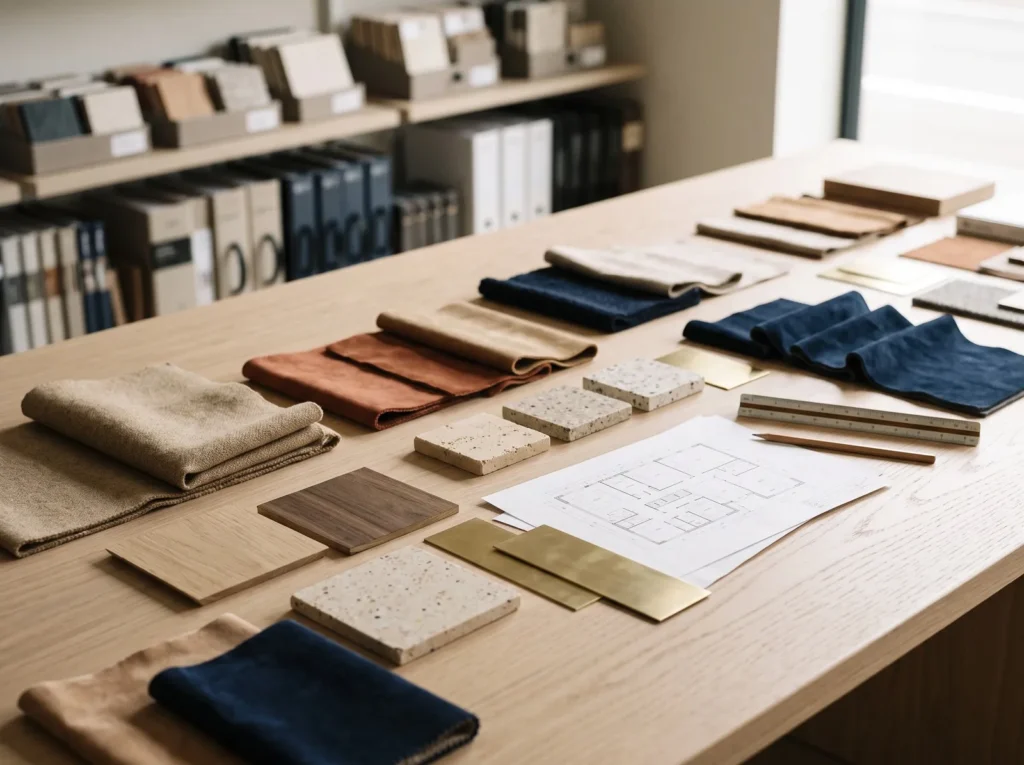
To get specified by an interior architect, a manufacturer must enter the studio’s product library before projects are decided. That means targeting the right studios, holding meetings centred on their projects, providing ready-to-use documentation and following up regularly through to the order. Specification is won over time, rarely at first contact.
Why specification happens at the interior architect’s studio
In a hotel, clinic or office project, products are chosen during design, well before the order. For public buildings, the French Public Procurement Code describes these stages: sketch design, preliminary design and detailed design studies, then assistance with awarding the works contracts, according to the list of design mission elements (article R2431-1). Private projects follow a similar logic.
It is during these studies that the interior architect sets the materials, finishes, sizes and performance levels. When contractors are consulted, the specifications are already written. We explain this process in our article on the contract market.
For a manufacturer, the goal is therefore to enter the studio’s product library: the selection of suppliers, catalogues, samples and digital files the team turns to when a project starts. A studio does not survey the whole market for each project. It starts from what it knows and what has already worked.
Two nuances matter:
- specifying is not buying: the architect recommends, then the project owner, fit-out contractor or buyer places the order, sometimes after a competitive tender;
- in public contracts, the brand gives way to performance: article R2111-7 of the Public Procurement Code only allows a brand to be named exceptionally, with the words “or equivalent”. Being specified then means seeing your characteristics written into the specifications.
The interior architect is not the only specifier. Design offices describe the technical packages (lighting, plumbing, interior finishing), fit-out contractors propose products in their bids, and the technical departments of hotel or healthcare groups sometimes impose their own standards. The method described here applies to each of them; we take the example of the interior architect, who is still the first to choose the look of a space.
How to identify the studios that matter to you?
The first mistake is to target every studio. A short, qualified list is worth more than a file of several hundred contacts. For each studio, ask four questions:
- Segment: does it work on hotels, healthcare, offices or senior living?
- Project size: a 30-room boutique hotel or a multi-storey headquarters? Your production capacity must keep up.
- Style: are its projects compatible with the look of your products?
- Activity: does it have current or recent projects?
Several sources complement each other to build this list:
- the projects studios publish on their websites and social networks, which show their clients and style;
- trade press on interior architecture, hospitality or commercial real estate, which announces openings and refurbishments;
- the professional directory of the French Council of Interior Architects (CFAI);
- award notices for public design contracts published on the BOAMP, the French public procurement bulletin, useful for public healthcare or residential projects;
- trade shows and professional events, where architects, interior designers and technical departments meet.
In each studio, also identify the right contact. The partner sets the direction, but the project architect often chooses the products day to day. In some studios, one person manages the material library and documentation: they decide what enters the library.
How to get a meeting and make it useful?
An architect receives many approaches from suppliers. To get a meeting, you need a reason that concerns them: a product suited to a type of project they run, a technical innovation, a recommendation from a peer, a trade show encounter to follow up.
The formats that work best remain simple:
- the studio presentation, short, in front of the project team;
- the workshop or showroom visit, which shows manufacturing, materials and the ability to adapt;
- the meeting about a specific project, when the studio is looking for a solution to an identified problem.
What to prepare
Before the meeting, look at the studio’s projects and choose three to five products relevant to its work, not the whole catalogue. Bring finish samples, technical data sheets and references from comparable spaces, with photos.
An effective studio presentation often follows the same sequence:
- a few minutes on your company, your workshops and your contract references;
- the products selected for the studio, with their options and limits;
- handling the samples, to judge materials and finishes;
- a discussion about the team’s current projects;
- the agreed next step: sending files, samples or prices, or a workshop visit.
What to listen for
The meeting is first about understanding. Ask the team about its current projects, its constraints (budget, lead times, fire performance, maintenance) and the products that cause it problems today. A manufacturer who asks good questions makes a stronger impression than one who recites a brochure.
What the architect expects from you
- reliable technical information they can use straight away;
- samples sent quickly;
- indicative prices to check the budget;
- a clear answer on what can be adapted, and with what lead times;
- commitments kept through to delivery.
How to follow a studio through to the project?
Specification is won over time. After the meeting, send what you promised within the week: files, samples, prices. Then keep regular, useful contact, each time a piece of information genuinely helps the studio:
- a new finish or colour;
- a new test report;
- a completed project in a comparable space;
- an invitation to a trade show or a workshop visit.
When a project comes up, be available at every stage. During sketch design, the studio needs images and ideas. During preliminary and detailed design, it asks for technical data sheets, dimensions, cost estimates for the quantity surveyor, sometimes a prototype. For public buildings, the Public Procurement Code even provides for the possible involvement of a supplier of industrial products from the preliminary design stage (article L2431-2).
Follow-up does not stop once the documents are handed over. Between specification and order, the fit-out contractor or buyer may propose a competing product deemed equivalent. Stay in touch with the architect, the project owner and the company in charge of purchasing, and keep ready the evidence that your product complies with the specifications.
A tracking tool (a CRM, or a simple shared spreadsheet) helps keep a record of the studios you have met, the projects identified, their stage and the next actions.
Which mistakes lose the specification?
- Presenting the whole catalogue: the architect remembers three products, not thirty.
- Arriving without technical documentation: without data sheets or test reports, the product cannot enter a specification.
- Promising the impossible: a missed lead time or adaptation closes the studio’s door for a long time.
- Disappearing after the meeting: a studio quickly forgets a supplier who does not follow up.
- Following up with nothing to offer: a message with no useful information wears the relationship down.
- Forgetting the buyer: being specified, then losing the order on price or lead time, often happens when the fit-out contractor and the project owner have not been kept informed.
- Responding too slowly: when a studio asks for a price or a sample, a project is often moving forward; a few days’ delay is enough for it to turn to another manufacturer.
- Targeting only the best-known studios: they are heavily solicited, while smaller studios run many projects.
Each product family has its own contacts: a lighting manufacturer will also work with lighting designers, an interior finishing manufacturer with design offices. We present these specifics on our manufacturers page, and we help those who wish to build their specification approach as part of our sales strategy support.
Key takeaway: getting specified means entering a studio’s product library before projects are decided. Target few studios, prepare each meeting around their projects, bring documentation they can use and follow the relationship through to the order.
Do you manufacture furniture, lighting or equipment and want to win contract projects? Find out how we support manufacturers, from strategy to the first orders.