
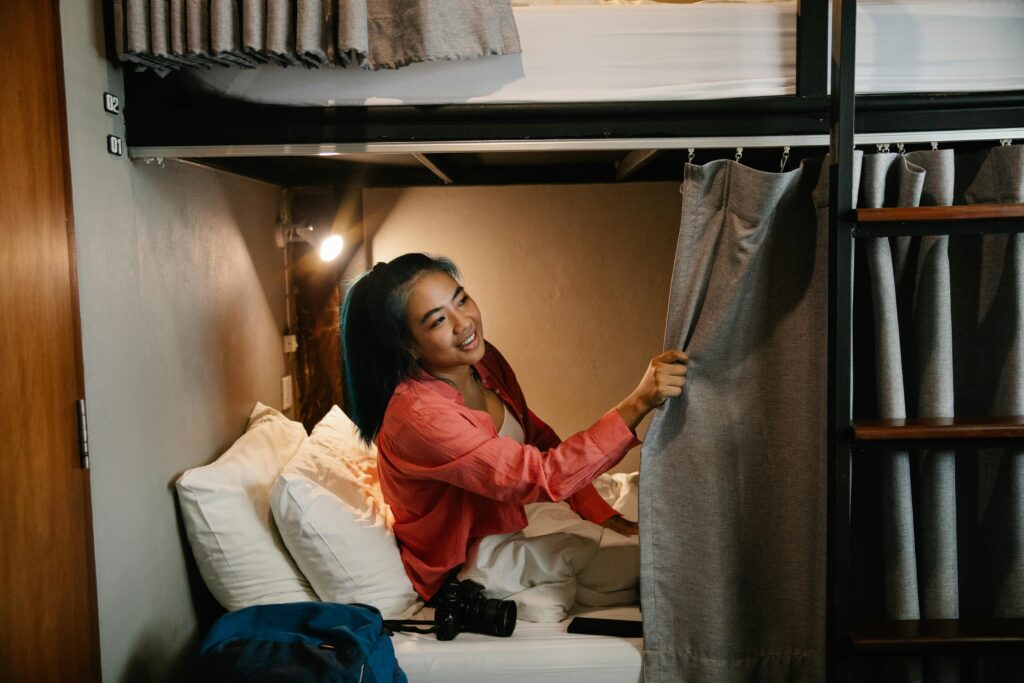
How do you fit out a youth hostel with modular, budget-friendly solutions? Bunk beds, functional furniture, lively communal areas: Softenza Consulting’s advice for your hostel project.
What makes a youth hostel fit-out different
The youth hostel, in its contemporary form, is a fast-changing sector. A far cry from the spartan dormitories of the past, new-generation hostels offer authentic, community-driven and cleverly designed travel experiences, with outstanding value for money.
Fitting out a youth hostel is fundamentally different from fitting out a conventional hotel: the aim is to maximise the number of beds per square metre while creating a pleasant, memorable stay. Modularity, functionality and durability are the watchwords of a successful fit-out.
At Softenza Consulting, we support group accommodation projects through the design and furnishing of their establishments.
Designing dormitories: the art of making the most of space
Bunk beds: the central choice of the fit-out
The bunk bed is the defining feature of a youth hostel. The model you choose has a direct impact on guest comfort, capacity and the durability of the equipment.
Criteria for choosing hostel bunk beds:
- Sturdy metal frame (round or square steel tubing): essential to withstand vibration and constant climbing up and down
- Headroom: allow at least 80 to 100 cm between the beds so that the guest on the lower bunk can sit up comfortably
- Built-in, secure ladder for the upper bunk
- Privacy curtain: now standard in modern hostels, it offers a minimum of privacy that guests appreciate
- Built-in storage: drawer under the lower bunk, bedside shelf, individual USB power socket
- Mattress suited to intensive use (in rotation 365 days a year): 15 to 20 cm thick, high-resilience or memory foam
Possible dormitory layouts
Contemporary hostels offer dormitories of different sizes to meet a range of expectations:
- 4- to 6-bed mixed dormitory: the ideal format, with a good balance between conviviality and privacy
- 8- to 12-bed dormitory: a budget format, suited to large establishments
- Single-sex dormitory: popular with women travelling solo
- Semi-private dormitory: an intermediate option (2 to 3 beds in an enclosed space), halfway between a dormitory and a private room
Modularity: adapting spaces to the seasons
Modularity is a major asset for youth hostels, where occupancy varies with the seasons. Movable partitions and modular furniture make it possible to adapt the layout:
- Turning a large dormitory into several smaller spaces in the low season
- Converting an activity room into an extra dormitory in the high season
- Adapting communal areas to different uses (events, evenings, workshops)
Communal areas: the heart of the hostel experience
In a youth hostel, communal areas are not simply spaces people pass through: they are the places where guests meet and share the community experience that makes a hostel stay what it is.
The shared kitchen
The shared kitchen is often the liveliest space in a hostel. It needs to be:
- Functional and robust: professional or semi-professional appliances, stainless steel or hard-wearing laminate worktops
- Well organised: enough storage (personal lockers with padlocks), a large table for shared meals
- Easy to maintain: smooth materials, accessible corners, removable equipment
Recommended furniture:
- A large communal table (8 to 12 people) in solid wood, or a sturdy canteen table
- Stackable stools or chairs (to save space during cleaning)
- A central island if the floor area allows
The lounge and relaxation area
The communal lounge is the hostel’s social showcase. It should invite guests to unwind and meet one another:
- Comfortable but hard-wearing sofas and armchairs (technical upholstery or faux leather)
- Reclaimed, second-hand or upcycled furniture: it adds character and reflects the values of backpackers
- Practical coffee tables for laptops and games
- Warm lighting, designed for the evening atmosphere
- A take-a-book, leave-a-book library (book exchange)
Work and connectivity areas
Digital nomadism has changed the way hostels are used. An informal coworking area has become essential:
- A desk or high table with plenty of power and USB sockets
- Ergonomic chairs or stools
- Reliable Wi-Fi (a major point of differentiation)
- Good natural light or neutral white LED lighting
Budget-friendly, sustainable solutions for youth hostels
Upcycled and reclaimed furniture
Youth hostels lend themselves particularly well to this: reclaimed, refurbished or upcycled furniture is not only economical, it also fits perfectly with the sustainability and authenticity that backpackers value.
Practical ideas:
- Recycled wooden pallets turned into tables, benches and shelves
- Recycled school or industrial lockers for storage
- Reclaimed wooden crates used as wall shelves
- Mismatched second-hand chairs that create an authentic atmosphere
Manufacturers specialising in hostel furniture
Some manufacturers and distributors specialise in contract furniture for group accommodation, with solutions designed for the intensive use hostels demand. These ranges generally include:
- Modular bunk beds with a wide choice of accessories
- Lockers with electronic code locks or key locks
- Compact, functional bedroom furniture
Bulk buying and standardisation
Standardising the furniture across all dormitories allows negotiated volume purchasing and simplifies maintenance logistics: when an item breaks, it can be replaced like for like straight away.
Standards and regulations for youth hostels
Official classification
In France, youth hostels can be classified under a specific framework or join accredited networks (FUAJ, the French youth hostel federation, and HIHF). These classifications set minimum standards for equipment and floor area per guest.
Public-access building (ERP) standards
As public-access buildings (ERP), youth hostels are subject to strict rules on fire safety, accessibility and hygiene:
- Smoke detectors, fire extinguishers and evacuation plans are mandatory
- Emergency lighting (exit signage)
- Access for people with reduced mobility (depending on the category of the establishment)
- Minimum spacing between beds (generally 80 cm)
Floor area per guest
Regulations set a minimum floor area per guest in dormitories. In France, the minimum is generally 5 m² per person in shared dormitories.
Investing in a hostel: what fit-out budget?
The fit-out budget for a youth hostel varies with its size and positioning:
- 30- to 50-bed hostel: furniture budget of €30,000 to €80,000
- 100- to 200-bed urban hostel: furniture budget of €80,000 to €200,000
- Large hostel (200 beds or more): from €200,000 for the furniture alone
The largest item is the bunk bed and its accessories (curtain, socket, locker), which often accounts for 40 to 50% of the total furniture budget.
Softenza Consulting: accelerating manufacturers in the group accommodation market
Softenza Consulting supports furniture and equipment manufacturers and suppliers who want to grow their presence in the contract market for youth hostels and group accommodation.
Our role: to build strategic bridges between manufacturers and the sector’s specifiers (hostel networks, youth accommodation groups, project developers) to maximise our partners’ business opportunities.
We work on business development strategy, range positioning (modular, budget-friendly and sustainable solutions), identifying and approaching the right contacts and building lasting partnerships.
Our approach: sector expertise, a qualified network and hands-on support to turn your offer into commercial success in the hospitality and group accommodation market.
Conclusion
Fitting out a youth hostel with modular, budget-friendly solutions is a balancing act between optimising capacity, guest comfort and staying within budget.
A well-designed hostel is a profitable hostel: every square metre put to good use, every lively communal area and every comfortable dormitory contributes directly to guest satisfaction and to the positive reviews that will build your establishment’s reputation.
Working on a youth hostel or group accommodation project? Talk to the experts at Softenza Consulting.
Do you manufacture furniture, lighting or equipment for the hospitality sector? Find out how we support manufacturers in the hotel and restaurant market.