
The contract market refers to fitting out professional spaces that host the public or employees: hotels and restaurants, healthcare facilities, offices, senior living residences. Products are chosen project by project, first by specifiers (interior architects, design offices, fit-out contractors), then bought by a project owner or an operator. For a manufacturer used to retail, it is a different sales channel, with its own rules.
What is the contract market?
Contract covers interior projects for professional spaces: a hotel refurbishing its rooms, a clinic equipping a new department, a company redesigning its offices, a senior living residence opening its doors. The term comes from “contract furniture”, furniture sold as part of a project, as opposed to furniture sold to consumers.
For a manufacturer, the difference from retail fits in one sentence. In retail, you sell a catalogue to retailers who sell on to consumers. In contract, you sell an answer to a project, chosen by professionals, for a space that will host the public or employees for years.
The market covers every family of interior products:
- furniture: beds and headboards, seating, tables, reception desks, storage;
- lighting: pendants, wall lights, lamps, ambient lighting;
- decoration: textiles, rugs, mirrors, objects, wall art;
- sanitaryware: basins, taps, shower screens, bathroom accessories;
- interior finishing: floor and wall coverings, partitions, ceilings, interior joinery.
These products share one thing: they are installed in regulated spaces. Most contract sites are public-access buildings (ERP), governed in France by the fire and panic safety regulations for ERP (order of 25 June 1980). The exact requirements depend on the type of building and the product: they must be checked for each project.
What are the main contract segments?
We distinguish four main segments. They are not subject to the same rules: the French authorities classify ERP by type, for example O for hotels, N for restaurants, U for healthcare facilities, J for care facilities for older people and W for offices and administrations, according to the classification published by Service-Public.
Hospitality
On 1 January 2026, France (excluding Mayotte) had 16,291 hotels and 660,489 rooms, including 3,088 hotels rated 4 or 5 stars, according to INSEE data on tourist accommodation. The stock keeps renewing: in February 2026, the consultancy In Extenso TCH listed 690 hotel projects totalling 52,500 rooms, according to Localtis (Banque des Territoires).
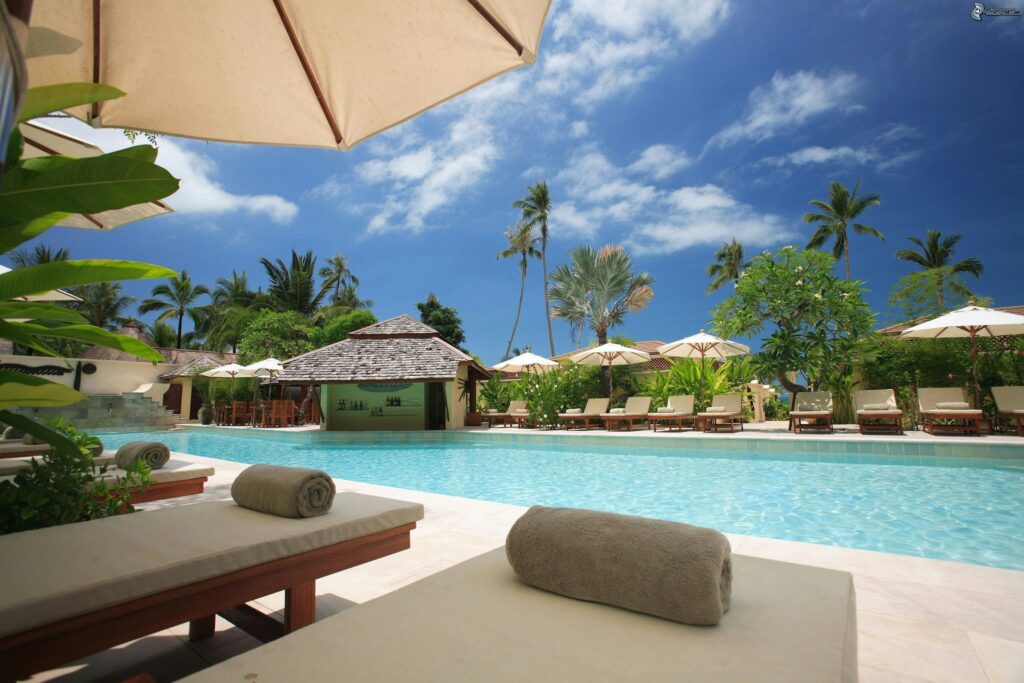
Hospitality also includes restaurants, bars and restaurant chains, whose concepts are often rolled out across several sites. We describe what this segment expects on our hospitality contract page.
Healthcare and care homes
At the end of 2023, France had 2,965 hospitals and clinics, according to the DREES overview of healthcare facilities. The care sector is just as significant: care homes (EHPAD) had 609,970 installed places in 2023, according to a DREES fact sheet on accommodation for older people.
Patient or resident rooms, waiting areas, dining spaces, nurses’ stations: products must be easy to clean, withstand strict hygiene protocols and serve vulnerable people as well as care staff. Our healthcare contract page sets out these expectations.
Offices
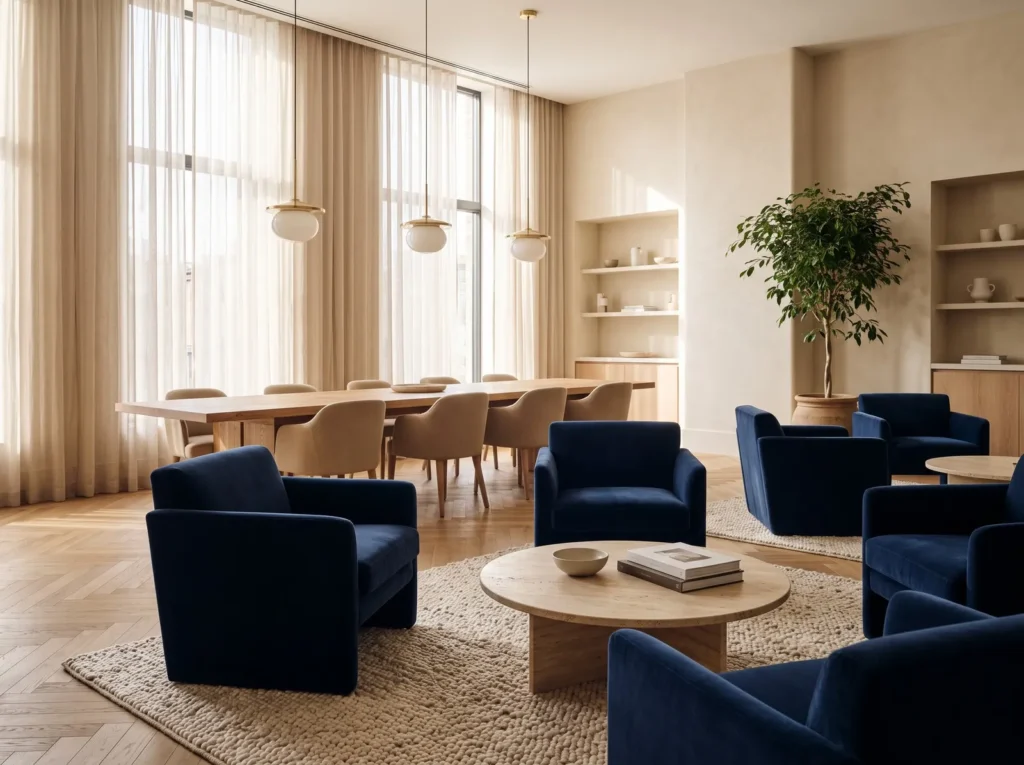
Headquarters, office floors, coworking spaces, corporate reception areas: the office sector buys work furniture, acoustic solutions, lighting and coverings. Projects are led by space planners, interior architects and project management consultants (AMO), often when a company moves or reorganises its space. See our office contract page.
Senior living residences
Senior living residences are a more recent segment. According to the Silvita observatory of senior residences (March 2026), France had 1,338 in operation at the end of 2025, with 108,286 housing units. Their number more than doubled between 2017 and 2025, although the observatory notes a clear drop in annual openings from 2025.
Operators look for a feel close to home or to a hotel, with the safety and ergonomics an older public requires: seat height, armrests, glare-free lighting, suitable floors.
Who chooses the products in a contract project?
In contract, the one who pays is not the one who chooses first. A project brings together several players:
- the project owner: investor, hotel group, hospital, company or local authority. It sets the budget and approves the choices;
- the project management consultant (AMO), who helps define the need and steer the project;
- the design team: architect, interior architect, interior designer, design office. It designs the project and writes the technical documents;
- the fit-out contractor or main contractor, who manufactures or buys, then installs;
- the operator, who will run the space and whose technical teams often have a say;
- the buyers: group procurement departments, public or private purchasing bodies.
The decisive moment is design. It is during the design studies that the architect selects products, finishes and performance levels. For public buildings, the French Public Procurement Code even provides for it: its article L2431-2 accepts that the design mission may vary depending on the involvement, from the preliminary design stage, of a supplier of industrial products.
In public contracts, the buyer cannot, in principle, impose a brand. Article R2111-7 of the same code only allows it in specific cases, and always with the words “or equivalent”. Being specified then means that your performance levels become the benchmark in the specifications. In private projects, the architect has more freedom to name a product.
Why contract is a growth driver for a manufacturer
The consumer market remains difficult. According to Xerfi, the French domestic furniture market stood at €13.6 billion in 2025, and its recovery is still awaited. Contract follows other cycles: openings, refurbishments, reorganisations, compliance upgrades.
For a manufacturer, the appeal lies in several points:
- volume orders: the hotel projects listed by In Extenso TCH average 76 rooms, often fitted out identically;
- recurring needs: contract spaces wear quickly and get refurbished;
- making the most of your know-how: specific finishes, sizes and colours are often requested, which favours manufacturers able to customise;
- visible references: a well-designed hotel or headquarters becomes a showcase for other specifiers;
- diversification: selling across several segments reduces dependence on a single distribution channel.
There is a real trade-off. Sales cycles are long, technical requirements higher and competition often international. You also have to accept convincing, first, people who do not buy themselves.
Where to start when you come from retail?
Entering the contract market takes preparation. Manufacturers who succeed usually follow five stages:
- Target: choose one or two segments where your offer is credible, rather than aiming at the whole contract market at once.
- Adapt the offer: select the products that will withstand intensive use, plan options (fabrics, finishes, sizes) and check the requirements of the segment.
- Document: precise technical data sheets, test reports, 2D and 3D files, environmental data such as FDES (environmental and health declarations), BIM objects if your specifiers work with digital models.
- Get known by specifiers: interior architects, design offices, fit-out contractors and operators’ technical departments.
- Organise: a dedicated project contact, fast quotes, logistics and after-sales service able to follow a site.
This is the approach we describe in our white paper “From Retail to Contract” (available in French), drawn from 15 years of supporting interior product manufacturers.
The next articles on this blog cover each stage in detail: specification, technical specifications, tenders and the requirements of each segment.
Key takeaway: contract is a market of projects, not catalogues. Products are chosen early by specifiers, according to use and regulatory requirements, then bought by a project owner or an operator. A manufacturer gets in by targeting a segment, adapting its offer and becoming known to those who design the projects.
Do you manufacture furniture, lighting or equipment and want to win contract projects? Find out how we support manufacturers, from strategy to the first orders.