
To become a hotel furniture supplier, a manufacturer must convince several players at once: the owner or investor, the brand and its standards, the interior architect who designs the project, the project management consultant and the fit-out contractor who buys and installs. It must also be ready on the product, the technical file, pricing and floor-by-floor delivery.
A large market driven by projects
Hospitality is often the manufacturers’ way into contract, which we present in our article on the contract market. On 1 January 2026, France (excluding Mayotte) had 16,291 hotels and 660,489 rooms, including 2,587 four-star and 501 five-star hotels, according to INSEE data on tourist accommodation.
There is no shortage of projects. In February 2026, the consultancy In Extenso TCH listed 690 hotel projects totalling 52,500 rooms, an average of 76 rooms per project, according to Localtis. The Île-de-France region accounted for 152 of them, with 14,667 rooms. These figures cover active projects; not all will go ahead, but they give the order of magnitude.
For a furniture supplier, these projects take several forms:
- openings: new builds or conversions of existing buildings into hotels;
- refurbishments: rooms, lobby, restaurant, meeting rooms;
- rebranding, when a hotel joins a brand and must adopt its standards;
- upgrades, linked to the star rating.
The rating matters: according to Atout France, which awards the stars, the criteria are checked every five years by a body accredited by Cofrac, with an additional mystery visit for 4 and 5 stars. These criteria cover equipment and customer services in particular, and the rating is valid for five renewable years, according to the French ministry in charge of businesses.
Who decides in a hotel project?
A manufacturer that wants to become a hotel supplier must first understand that it does not have a single customer. Depending on how the project is organised, several players are involved in choosing the furniture:
- the owner or investor (independent hotelier, property company, fund, family group): it finances the project, sets the budget per room and expects a return on investment;
- the hotel group or brand: whether directly managed, franchised or under a management contract, it often imposes brand standards, with dimensions, equipment and sometimes approved suppliers;
- the operator (hotel management, technical department): it thinks about maintenance, durability and replacement;
- the interior architect or designer: it creates the concept, designs the bespoke pieces and chooses catalogue products;
- the project management consultant (AMO) or project manager: it holds the budget and schedule and organises the tenders;
- the fit-out contractor, main contractor or specialist purchasing agent: it prices, buys, manufactures part of the furniture and installs it.
In international projects, the furniture and decorative equipment package is called FF&E (furniture, fixtures and equipment), and operating supplies such as linen or tableware are called OS&E (operating supplies and equipment). A furniture manufacturer sits in the first.
The weight of each player varies. In an independent hotel, the owner and the architect often decide together. In a branded hotel, the brand standards frame the choices, and the group’s technical department can approve or reject a product. Before prospecting, identify who holds the decision on the target project. The method for approaching studios is set out in our article on getting specified by interior architects.
How does a hotel project unfold for a supplier?
The stages vary with the size of the hotel, but the logic stays the same:
- Brief and concept: the owner defines the positioning and budget; the architect proposes a look and feel. The manufacturer must already be known to the studio to appear on the first mood boards.
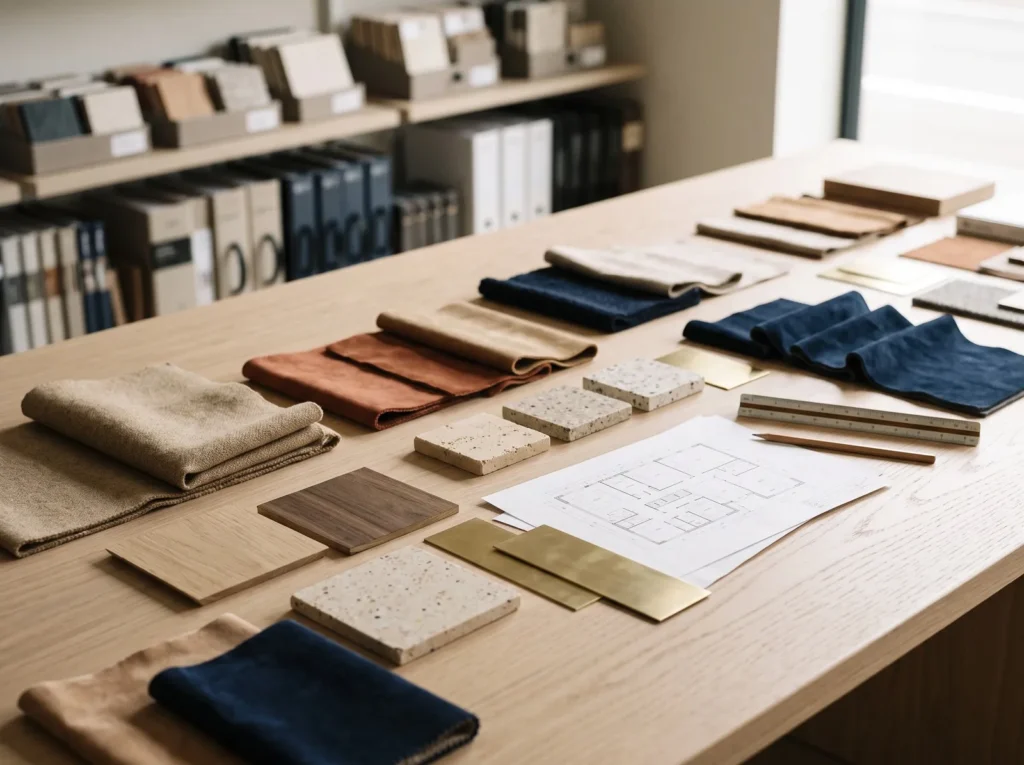
- Detailed design: plans, product selection, finishes, descriptions. The studio asks for technical data sheets, dimensions, samples and indicative prices.
- Tender: the furniture package is priced by several manufacturers or fit-out contractors. Alternatives may be proposed, and negotiation covers price, lead times and delivery terms.
- Prototype and approval: key pieces are made once, often installed in a mock-up room, then approved or corrected.
- Production and delivery: when the hotel stays open during the works, refurbishment often proceeds floor by floor, with deliveries timed to the schedule.
- Installation and handover: installation, clearing of snagging items, then after-sales service during operation.
Between the first presentation and delivery, several months may pass, or even several years for an opening. A manufacturer must therefore manage projects at very different stages at the same time.
What a manufacturer must prepare to be selected
An offer designed for hotels
A hotel product lives for years with different guests every night and daily housekeeping. Specifiers look at:
- the strength of frames and joints, and the durability of fabrics and finishes;
- how easy it is to clean and to replace wearing parts (covers, tops, bases);
- the fit with room dimensions, which are often tight;
- the ability to customise: colours, customer’s own fabrics, sizes, bespoke headboards and banquettes.
A regulatory and technical file
A hotel is a type O public-access building (ERP), according to the classification published by Service-Public. It falls under the fire and panic safety regulations for ERP, and the project specifications set the fire performance required for seating, textiles and decoration. These requirements must be checked for each project. Prepare test reports for your materials, technical data sheets, maintenance instructions, warranties and, if possible, environmental data and BIM objects.
Project pricing and logistics
- a price set for the project quantities, with or without transport and installation;
- realistic production lead times, prototypes included;
- packaging and labelling by room or by floor;
- an installation solution, in-house or with a partner;
- availability of spare parts and identical products for several years, to replace whatever breaks.
A dedicated sales organisation
A contact who knows hospitality, presentable references (photos, venues, quantities), a presence at sector trade shows such as EquipHotel in Paris, and rigorous follow-up of ongoing projects. This is often what manufacturers coming from retail lack.
Market watch is part of this organisation: opening and refurbishment announcements in the hospitality press, development plans published by groups, projects presented by architecture studios. The earlier you spot a project, the better your chances of being consulted before the choices are settled.
Which mistakes should you avoid on a first hotel project?
Manufacturers approaching hospitality for the first time often stumble over the same points:
- offering a retail product as it is: a fabric, foam or joint designed for domestic use will not necessarily withstand hotel use;
- underestimating production: delivering dozens of identical pieces on the same date, with no colour variation, requires a different workshop organisation;
- leaving costs out of the price: packaging by room, transport, storage, installation and rework weigh heavily if they are not priced from the start;
- talking only to the architect: if the brand or the technical department has not approved the product, the specification can fall through at ordering;
- neglecting after delivery: a hotel that cannot find an identical chair two years later will not come back to you.
A modest first project delivered well is often worth more than a large project handled badly: it becomes a reference you can show to the next specifiers.
We help furniture manufacturers prepare these elements and meet hospitality specifiers; details of this market are on our hospitality contract page.
Key takeaway: becoming a hotel furniture supplier means convincing several decision-makers (owner, brand, architect, AMO, fit-out contractor) with a durable, customisable product, a complete technical file, project pricing and logistics able to deliver floor by floor.
Do you manufacture furniture, lighting or equipment for the hospitality sector? Find out how we support manufacturers in the hotel and restaurant market.